
Website redesign lessons
What We Learned Redesigning the Phast Media Website
A website redesign is rarely just about aesthetics. During the redesign of the Phast Media website, several important lessons emerged around structure, branding, SEO, user experience and long-term website growth.
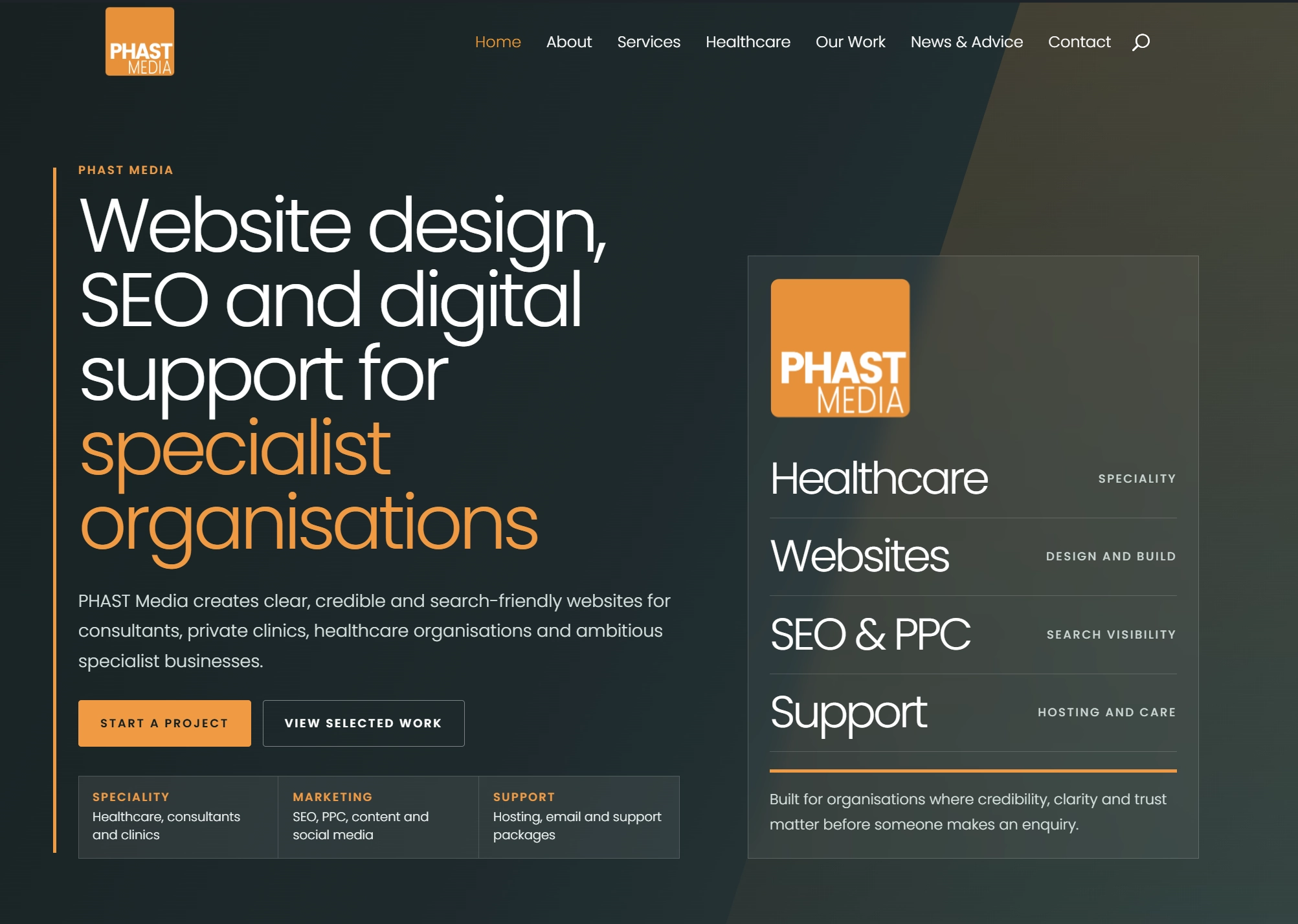
Recently I completed the redesign and rebuild of the Phast Media website.
While Phast Media is not a direct client of Stuart Gould Design, I have worked closely with the agency for many years in a freelance and white-label capacity and was responsible for the design and development of the new website.
That long-standing relationship meant I already had a strong understanding of the business, its clients, its services and its future direction. Rather than simply refreshing the visual design, the project provided an opportunity to rethink the website structure, strengthen the agency's positioning and create a platform that better reflected the quality of work being delivered today.
While every website project is different, the redesign highlighted several lessons that apply to almost every business website, regardless of industry.
Many of these lessons are things I see repeatedly when reviewing existing websites for businesses considering a redesign.
1. Every website eventually outgrows itself
Most websites start with a clear purpose. Over time, services evolve, new pages are added, priorities change and content grows.
What was once a simple website can gradually become difficult to navigate and harder to manage.
One of the biggest goals of the Phast Media redesign was simplifying and modernising the structure so users could find important information more quickly.
This is often one of the clearest signals that a website redesign may be needed.
2. Website structure matters more than most people realise
Design attracts attention, but structure determines how people move through a website.
Poor website architecture creates confusion for both users and search engines.
A redesign provides an opportunity to review:
- Navigation
- Service pages
- Internal linking
- User journeys
- Calls to action
- Search visibility
The stronger the structure, the easier it becomes for visitors to understand what a business does and what they should do next.
3. Businesses evolve and positioning needs to evolve too
One challenge with established businesses is that their websites often represent who they were rather than who they are today.
Over the years, Phast Media has developed particular expertise within healthcare and professional services while continuing to support a wide range of industries.
The redesign created an opportunity to better communicate that specialist experience without narrowing the agency's appeal.
Many businesses face exactly the same challenge as they grow.
4. Design trends move on
A website does not need to chase every trend, but visual expectations change over time.
Layouts, typography, spacing and user expectations continue to evolve.
One of the aims of the redesign was to create a cleaner, more mature and more professional visual style that better reflected the quality of the agency's work.
Good design should support credibility rather than distract from it.
5. SEO should influence the redesign from the start
SEO is often treated as something that happens after a website launches.
In reality, many of the most important SEO decisions are made during planning and development.
These include:
- Page structure
- URL structure
- Internal links
- Service hierarchy
- Metadata
- Content planning
- Schema opportunities
The strongest redesigns combine user experience and SEO from day one rather than treating them as separate tasks.
6. Launch day is only the beginning
One of the biggest misconceptions about website projects is that everything finishes when the website goes live.
The reality is that launch day simply starts the next phase.
Search engines begin discovering pages, analytics starts collecting real data and opportunities for further content become clearer.
The websites that perform best over time are usually the ones that continue to evolve after launch.
Final thoughts
The Phast Media redesign reinforced something I see on almost every project: successful websites are rarely about one big design idea.
They are usually the result of good planning, clear structure, thoughtful content, strong technical foundations and ongoing refinement.
Whether you're considering a complete redesign or simply trying to improve an existing website, taking a step back and reviewing the bigger picture often delivers the biggest gains.
You can also read the accompanying Phast Media Website Redesign Case Study to see how these principles were applied in practice.
Planning a website redesign?
I help businesses and agencies redesign websites that improve user experience, SEO, performance and long-term growth.
Explore Website Redesign Services